How Were Flowers Used in Ancient Coronations?
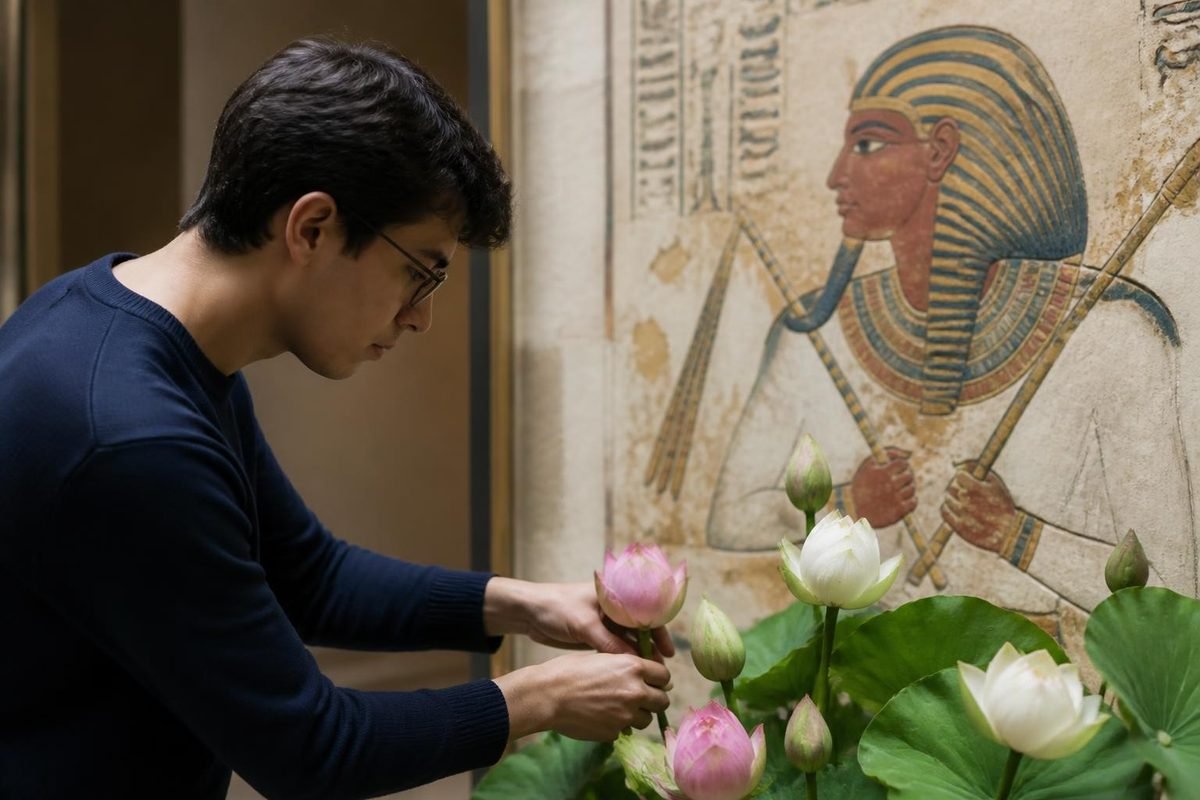
Flowers could adorn a ruler, decorate a ceremonial setting, or be scattered in celebration during an ancient coronation. The evidence varies by place: literary accounts describe floral celebrations, while surviving objects and images show how plants could express royal and sacred power.
Flowers in accounts of Indian coronations
In the Sanskrit epic Ramayana, the coronation of Rama is described as a moment of joy and abundance. Flowers appear among the signs of celebration, and the story tells of flowers being scattered from the heavens. Their presence helps make the ceremony feel both public and sacred.
The Ramayana is a literary work, not a report by someone who witnessed a coronation. It tells us how its authors and audiences imagined an ideal royal ceremony. It cannot establish that every historical coronation followed the same pattern.
Garlands were also familiar offerings in South Asian religious and social life. A garland placed around a person could honor that person, while flowers offered at a shrine could mark devotion. These associations help explain why flowers were suited to stories about a king taking up a sacred responsibility.
Plants and the appearance of power
Flowers were not the only plants associated with rulers. Leaves, stems and plant motifs could also give a ceremony or an image of kingship a recognizable meaning. A crown made from metal might last for centuries; a wreath of fresh plants was meant to be seen for a much shorter time.
Different traditions gave plants different roles:
- In the Ramayana, flowers scattered from above add a divine dimension to Rama's coronation.
- In ancient Egypt, the lotus was associated with rebirth and appeared in art alongside gods and royalty.
- In ancient Rome, laurel wreaths were associated with victory and were worn by emperors as signs of authority.
These examples should not be treated as one shared coronation custom. The Egyptian lotus and Roman laurel help explain the wider language of plants and power, but their use in royal imagery does not by itself prove that they were used at a particular crowning.
What remains of a floral ceremony
Fresh flowers decay quickly. A written description, a carved image or traces of a dried garland may survive, but each offers a different kind of evidence. A poet may describe a shower of blossoms to convey divine approval rather than record a physical event.
Images can be difficult to read, too. A ruler holding a flower may be shown making an offering or receiving a symbol of life. Without an inscription or another source identifying the scene as a coronation, it is safer not to call it one.
Flowers could make the arrival of a ruler visible and memorable, yet their brief life leaves much of the ceremony beyond our view. What remains often tells us as much about the meaning people gave to kingship as about the precise sequence of a coronation.
Take a look at name-days and holidays in Poland